
Why New York Uses the Supreme Court
New York names its trial court the Supreme Court. That trips up people who expect the Supreme Court to be the high court, the way it works in most states and in the federal system. Here it is the opposite. The Supreme Court is the trial court of general jurisdiction. The highest court in New York is the Court of Appeals in Albany.
In Erie County the Supreme Court handles major civil suits, divorce and separation, annulment, mortgage foreclosure, large money claims, and guardianship. It can hear felony matters by law, but outside New York City most felonies move to County Court after indictment. This split matters when you search for a record. A divorce belongs to Supreme Court even when the same family has a support or custody case in Family Court. Knowing the right court saves a wasted call.
The official Erie County courts landing page explains the chief clerk and jury office roles. See it at publicredesign2025.nycourts.gov/erie. That page is a good first stop before any visit.
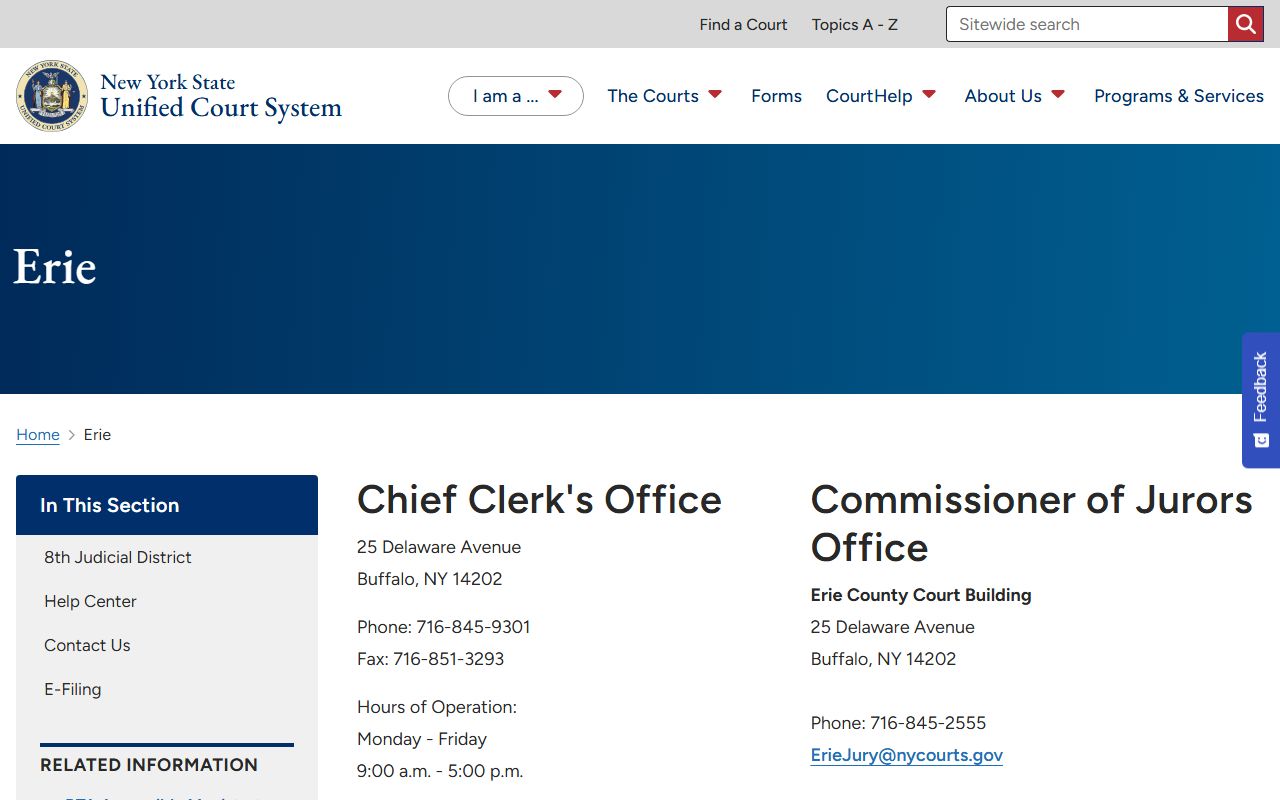
It links to the Supreme, County, and Family Court pages plus jury duty and clerk contacts in one place.
Erie County Supreme Court Location
The Supreme and County Court functions cluster in downtown Buffalo. Most Supreme Court parts sit in the Erie County Court Building at 25 Delaware Avenue, with some functions near 92 Franklin Street and 50 Delaware Avenue. The Chief Clerk's Office is the hub for case questions, jury matters, and court records help.
Erie County Supreme Court
Erie County Court Building
25 Delaware Avenue
Buffalo, NY 14202
716-845-9300
Chief Clerk: 716-845-9301
Generally 8:30 a.m.-5:00 p.m.
The captured Supreme Court page lists location, hours, and the justice roster for Erie County. View it at the official court page.
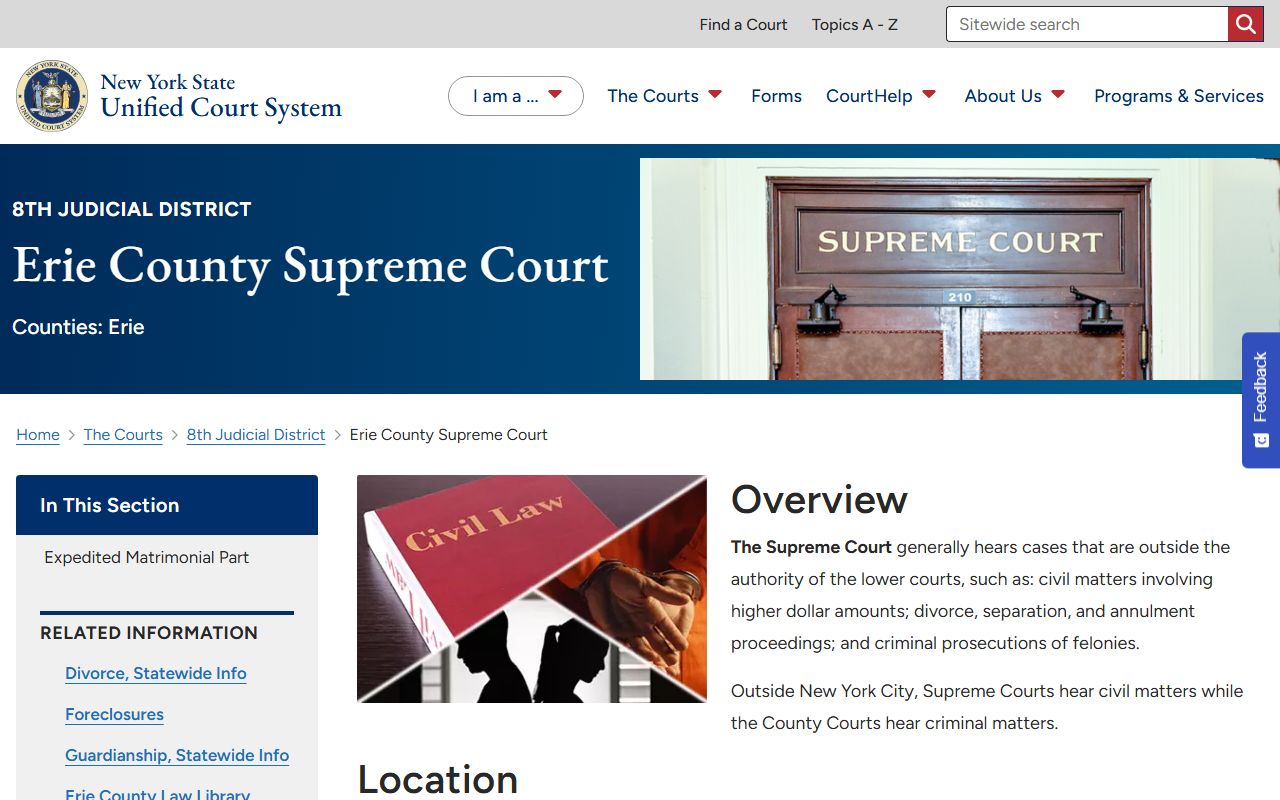
It also shows part numbers, floors, and individual court clerk phone numbers tied to each justice.
Trial Courts in Erie County
Erie County sits in the Eighth Judicial District of the New York State Unified Court System. Several trial courts share the work, and each holds its own records. The table lists the main courts, where they sit, and what they do.
| Court | Address | Phone | Role |
|---|---|---|---|
| Supreme Court | 25 Delaware Ave, Buffalo | 716-845-9300 | Major civil, divorce, foreclosure, guardianship; felony jurisdiction by law. |
| County Court | 25 Delaware Ave, Buffalo | 716-845-9301 | Felony criminal cases and some appeals and limited civil work. |
| Family Court | 1 Niagara Plaza, Buffalo | 716-845-7444 | Custody, support, paternity, family offense, neglect, juvenile cases. |
| Surrogate's Court | 92 Franklin St, 2nd Fl, Buffalo | 716-845-2560 | Probate, estates, wills, estate guardianship, adoption. |
| Buffalo City Court | 50 Delaware Ave, Buffalo | 716-845-2600 | Misdemeanors, civil to $15,000, small claims to $5,000, housing. |
| Town and Village Courts | Local municipal offices | varies | Traffic, violations, misdemeanors, small claims, civil to $3,000. |
Appeals from these courts route to the Appellate Division, Fourth Department in Rochester, then to the Court of Appeals in Albany. For document searches across these courts, see Erie County court records and the live calendars on the court dockets page.
County Court and Felony Cases
Erie County Court is the main felony trial court for the county. Outside New York City, County Court is where serious criminal cases land after a grand jury indictment or a superior court information. It shares the Erie County Court Building at 25 Delaware Avenue with Supreme Court parts. It also handles certain appeals from local courts and some limited civil work.
Most criminal cases do not start in County Court. An arrest usually leads to arraignment in Buffalo City Court or a town or village court first. The case then moves up if it is a felony. For arrest data and the criminal case path, see the arrest records page.
Family and Surrogate's Courts
Two more trial courts handle work that never goes to Supreme Court. Family Court at 1 Niagara Plaza hears custody, visitation, child support, paternity, family offense, neglect, abuse, and juvenile delinquency cases. Its records are restricted from public view under Family Court Act § 166, so most files are not open the way civil filings are. The Family Court Record Room line is 716-845-7401.
Surrogate's Court at 92 Franklin Street is New York's probate court. It handles wills, estates, estate administration, estate guardianship, and adoptions. For estate searches and filing fees, see the Surrogate's Court page.
The Family Court page below lists departments, judges, and the records phone. See it at the official Family Court page.
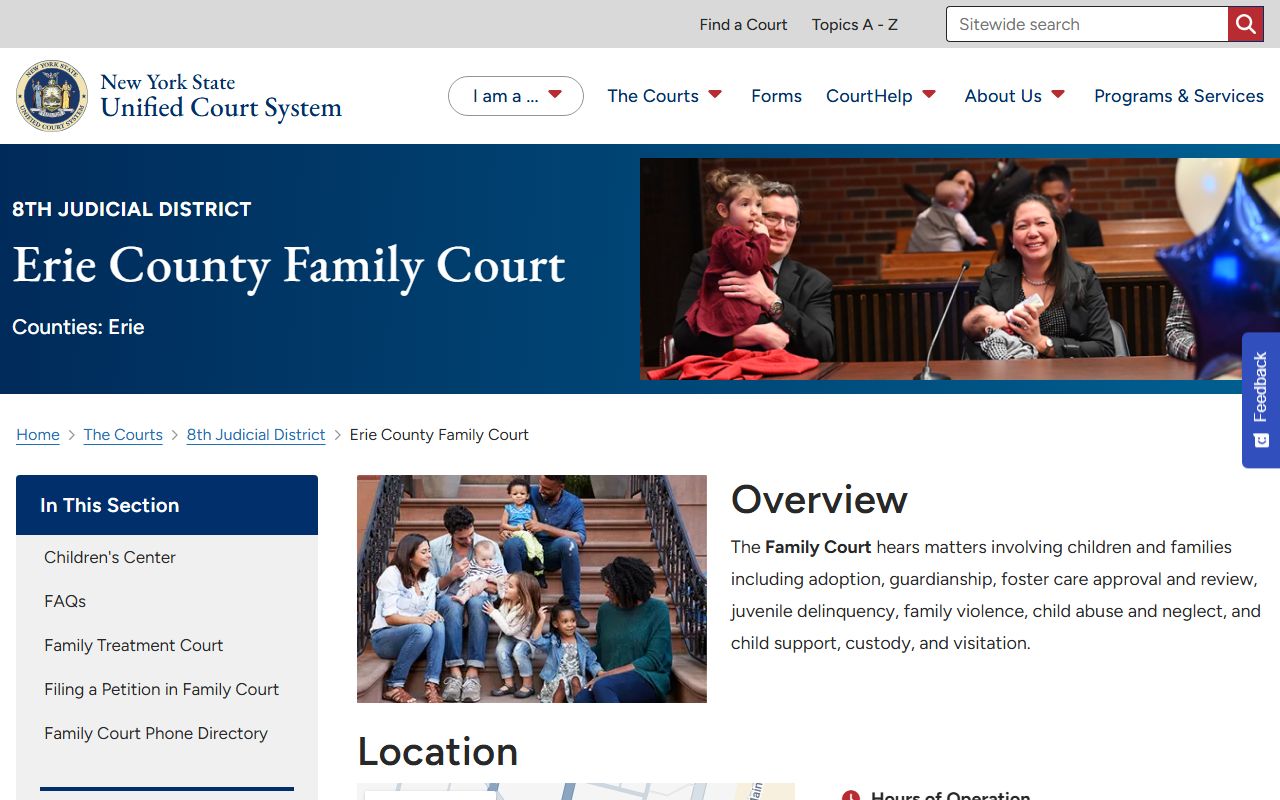
Family Court parts cover abuse and neglect, family offense, juvenile delinquency, PINS, custody, support, and permanency review across several floors.
Buffalo City Court and Justice Courts
Buffalo City Court at 50 Delaware Avenue handles the high-volume local cases. It hears misdemeanors and lesser offenses, felony arraignments, civil claims up to $15,000, small claims up to $5,000, and landlord-tenant disputes through its housing court. It has separate departments for criminal records, the civil judgment room, small and commercial claims, and housing.
Outside Buffalo, town and village justice courts do similar work. They handle traffic tickets, violations, misdemeanors, local code cases, and small civil claims up to $3,000. A landlord-tenant case in Buffalo goes to City Court housing court, while the same kind of case in a suburb often goes to the local justice court. For traffic tickets and how those courts split the work, see traffic court records.
How a Case Moves Through the System
Case routing in New York depends on the subject. A few common paths show how the trial courts connect. The flow is not always linear, but these are the usual routes.
- Felony criminal: Arrest → arraignment in City or town/village court → indictment → County Court → Appellate Division, Fourth Department.
- Major civil or divorce: Filing in Supreme Court → motions and trial → judgment → Appellate Division, Fourth Department → Court of Appeals.
- Estate or will: Petition in Surrogate's Court → probate or administration → accounting and distribution.
Because of this split, a single family can have records in three courts at once. The Erie County Clerk may hold filed legal records and closed criminal and divorce files, while live calendar data sits in the state systems.
Supreme Court vs County Court vs City Court
The three downtown trial courts are easy to mix up. This comparison shows the main differences in what they hear and the records they keep.
| Feature | Supreme Court | County Court | Buffalo City Court |
|---|---|---|---|
| Main cases | Major civil, divorce, foreclosure | Felony criminal, some appeals | Misdemeanors, small civil, housing |
| Civil limit | No dollar limit | Limited civil role | Up to $15,000 |
| Criminal role | Felony by law, rare in practice | Felony trials | Arraignments, misdemeanors |
| Address | 25 Delaware Avenue | 25 Delaware Avenue | 50 Delaware Avenue |
Note: a divorce always goes to Supreme Court in New York, even when related support or custody issues are pending in Family Court.
Appeals to the Fourth Department
Appeals from Erie County trial courts go to the Appellate Division, Fourth Department, based in Rochester. That court reviews civil and criminal appeals for Western New York. From there, a case may seek review at the New York Court of Appeals in Albany, the state's highest court. Most cases never reach that level. The Court of Appeals takes a limited set of appeals each year.
Justices and Court Parts
Erie County Supreme Court has a roster of justices, each assigned to a part with its own rules. The District Administrative Judge oversees the Eighth Judicial District. Recent court pages name justices such as Hon. Amy C. Martoche as District Administrative Judge, plus Hon. Betty Calvo-Torres, Hon. Deborah A. Chimes, Hon. Emilio Colaiacovo, Hon. Diane Y. Devlin, Hon. John B. Licata, and Hon. Joseph Lorigo, among others.
Each part lists a part number, floor, and a court clerk phone number. Individual Assignment System rules differ by justice, so check the part rules before filing motions or papers. The court page is the source for the current roster and part assignments, which change as judges rotate.