
How to Find Recent Erie County Arrests
There is no single arrest-record portal for the county. The path depends on whether the person is still in custody and whether the case is open. Start with the source that matches the question.
- For someone still in jail, check the Erie County Sheriff's public inmate roster, posted as a PDF on the Sheriff's site.
- For a pending criminal case or a court date, use WebCrims, the state public criminal case lookup.
- For a closed criminal file, request a local criminal record search through the Erie County Clerk's Actions and Proceedings Office.
- For a statewide background check, use the New York State DCJS criminal history process.
WebCrims is a calendar and case-status tool, not an all-time arrest archive. Sealed, dismissed, and youthful offender matters do not appear. The Sheriff roster is a point-in-time list, so a name can drop off after release. Treat both as snapshots, not full histories.
Erie County Sheriff and Booking
The Erie County Sheriff's Office books people into the county jail system. Sheriff John C. Garcia leads the office. The Jail Management Division runs two facilities, the Holding Center downtown and the Correctional Facility in Alden. Booking creates the first record of an arrest, with the charge, date, and custody location.
Erie County Holding Center
40 Delaware Avenue
Buffalo, NY 14202
Downtown pretrial facility
Correctional Health: 716-858-8931
For the jail roster, custody details, and visitation, see the inmate records page. A person missing from the roster may have been released, transferred to state prison, or moved to federal custody.
What an Erie County Arrest Record Shows
An arrest record captures the basic facts of a booking. The exact fields vary by agency, but most records carry the same core data. Knowing the fields helps you read a roster entry or a case result.
- Name and any listed aliases.
- Booking or custody identifier.
- Facility or custody location.
- Charge or hold reason and the statute cited.
- Booking date and arresting agency.
- Court date or disposition once the case moves forward.
An arrest record does not prove a crime. It records that police took someone into custody on a stated charge. Whether that charge sticks is up to the court. The case may end in a plea, a trial, a dismissal, or a sealed result.
Arrest Record vs Criminal Court Record
People often mix up an arrest record with a full criminal court record. They are different files held by different offices. This comparison shows how they split.
| Feature | Arrest Record | Criminal Court Record |
|---|---|---|
| Held by | Sheriff or arresting police agency | Court clerk and County Clerk |
| Created when | At booking | When a case is filed in court |
| Shows | Charge, booking date, custody status | Pleas, motions, disposition, sentence |
| Where to look | Jail roster, Sheriff | WebCrims, County Clerk, court |
For the full case history, including pleas and sentencing, use the Erie County court records page. The arrest is just the first entry in a longer file.
Charges vs Convictions
A charge is an accusation. A conviction is a finding or plea of guilt. The gap between them matters a lot when reading any criminal record. Many charges never become convictions.
- Charge
- The offense police or the prosecutor say a person committed.
- Conviction
- A guilty plea or a guilty verdict after trial.
- Disposition
- The final outcome, such as guilty, dismissed, or acquitted.
- Dismissal
- The case ends with no conviction; it may be sealed.
A booking entry shows the charge at arrest. The charge can be reduced, dropped, or changed as the case moves through court. Never read an arrest charge as a final result.
Mugshots in Erie County
A mugshot is the booking photo taken when police process an arrest. The Erie County Sheriff's official inmate roster is a PDF, and no public mugshot profile page was found on the Sheriff's official site. Some warrant listings on the Sheriff site may carry a photo, but a general public mugshot gallery is not part of the official county system.
Be careful with third-party mugshot sites. They often repost old booking photos and may not reflect the case outcome. Official county and court sources are the reliable path. For active warrants that may include a photo, see warrant records.
Sealed vs Expunged Records
New York is mostly a sealing state, not an expungement state. Sealing limits public access. Expungement, which destroys a record, is rare and mostly tied to certain marijuana cases. The difference shapes what shows up in any search.
| Point | Sealed | Expunged |
|---|---|---|
| What happens | Public access is blocked | The record is destroyed or removed |
| Who can still see it | Law enforcement, courts, some licensing | Generally no one |
| Common in New York | Yes, the usual relief | Rare, mostly marijuana cases |
| Statute | CPL § 160.50, § 160.59 | Cannabis reform rules |
A case that ends in favor of the accused is sealed under CPL § 160.50. Eligible old convictions may be sealed under CPL § 160.59 after a waiting period, though violent and sex offenses are excluded. Certain noncriminal outcomes are sealed under CPL § 160.55.
The CPL § 160.50 sealing statute is shown below. See it at the New York Senate site.
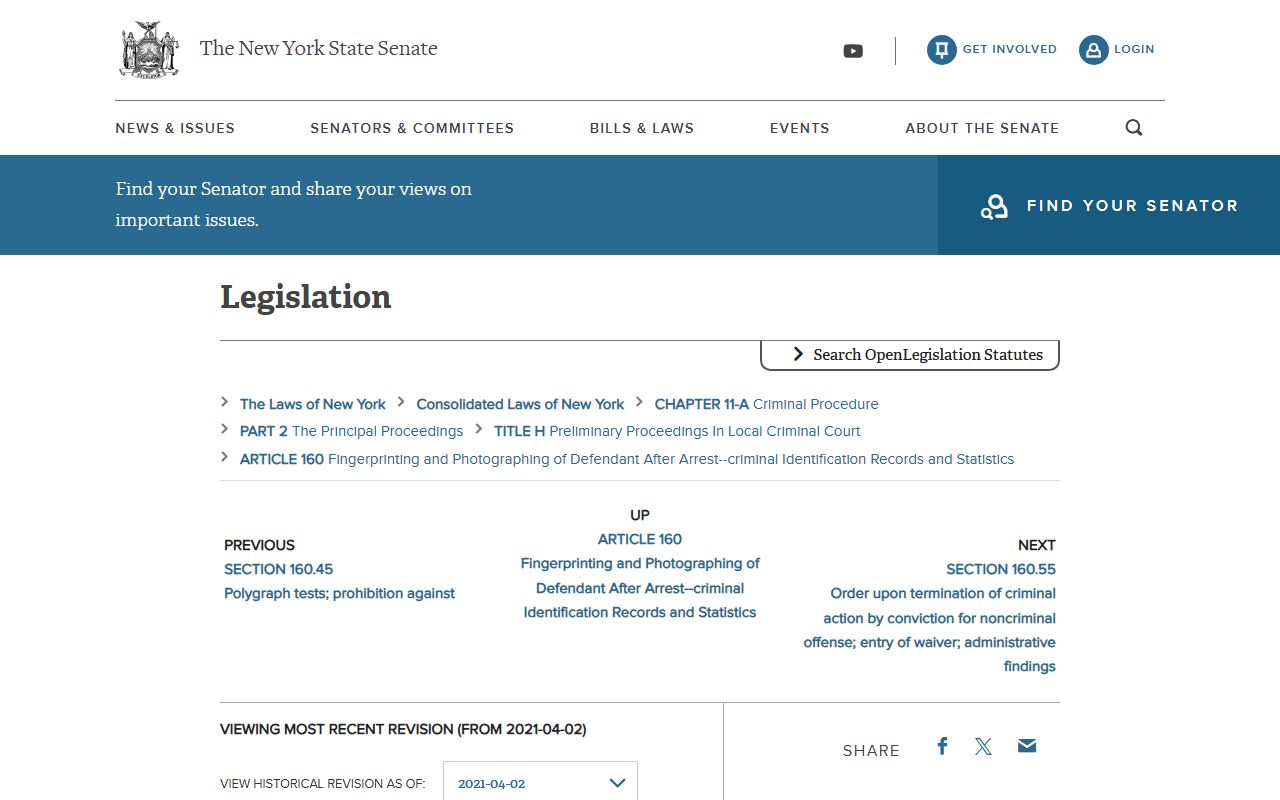
Note: a sealed record does not vanish; police, prosecutors, and some agencies may still access it under the statute's exceptions.
The District Attorney's Role
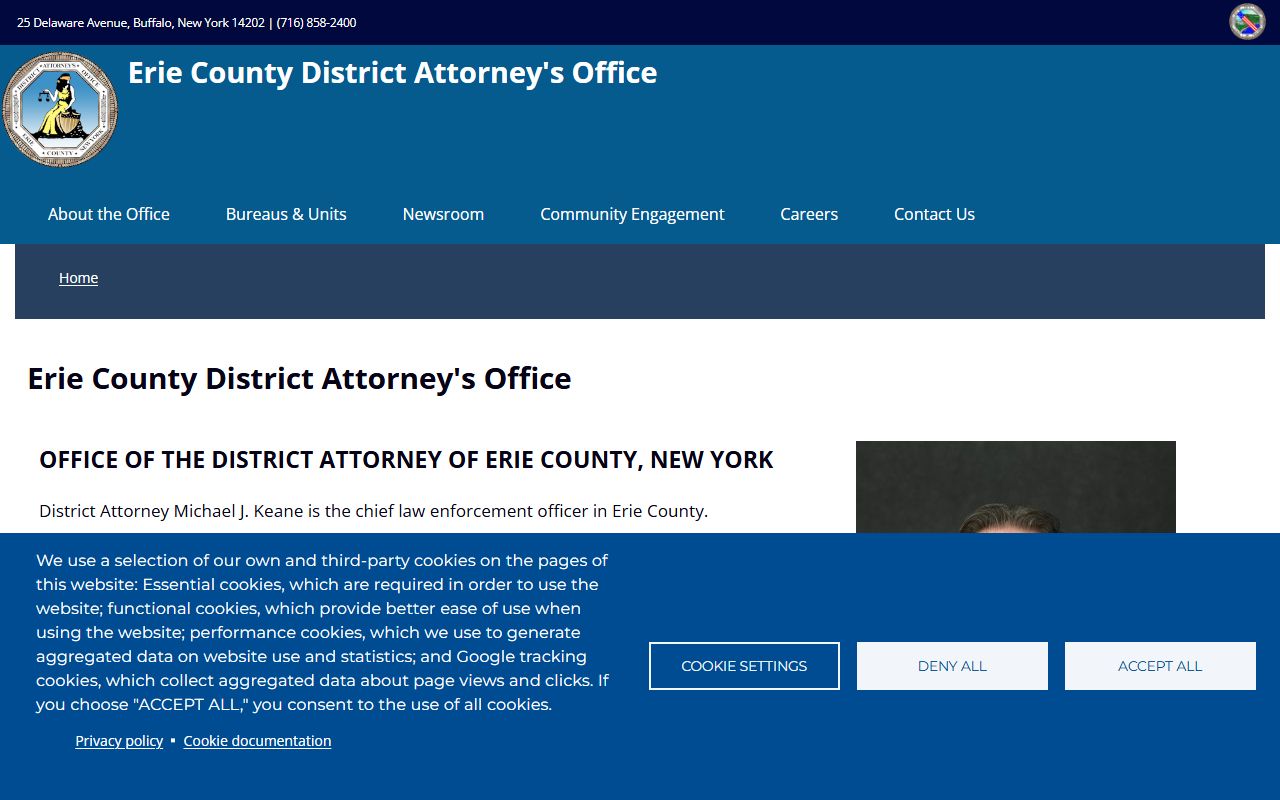
The Erie County District Attorney decides what charges to bring after an arrest. District Attorney Michael J. Keane leads the office, which the DA describes as litigating about 25,000 cases a year in local, county, state, and specialty courts. The office presents felony evidence to the grand jury and handles appeals.
The DA office page names the office's role and contacts. See it at the DA's official page.
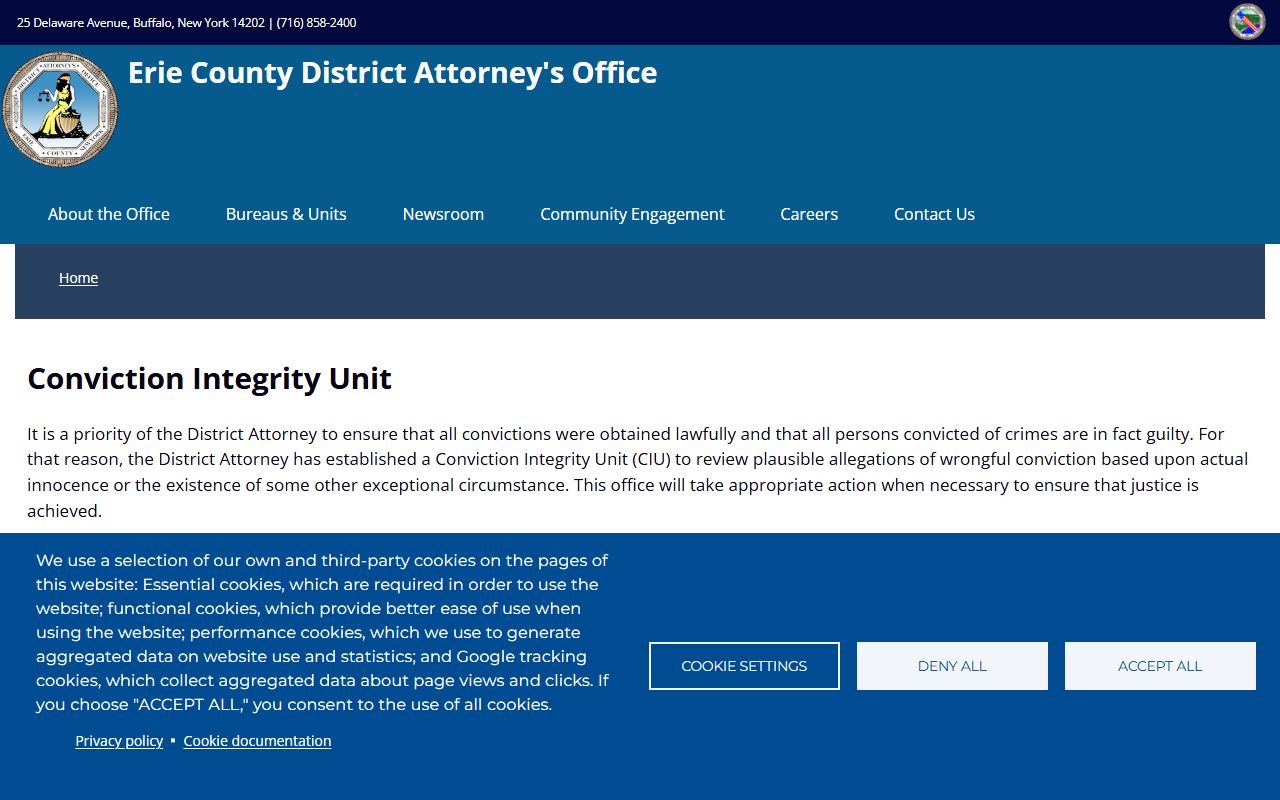
The office also runs a Conviction Integrity Unit that reviews claims of wrongful conviction. Its standards and contact appear below. See the Conviction Integrity Unit page.
Recent DA press releases announce indictments in serious cases. One such release is shown below. View it at the DA press page.
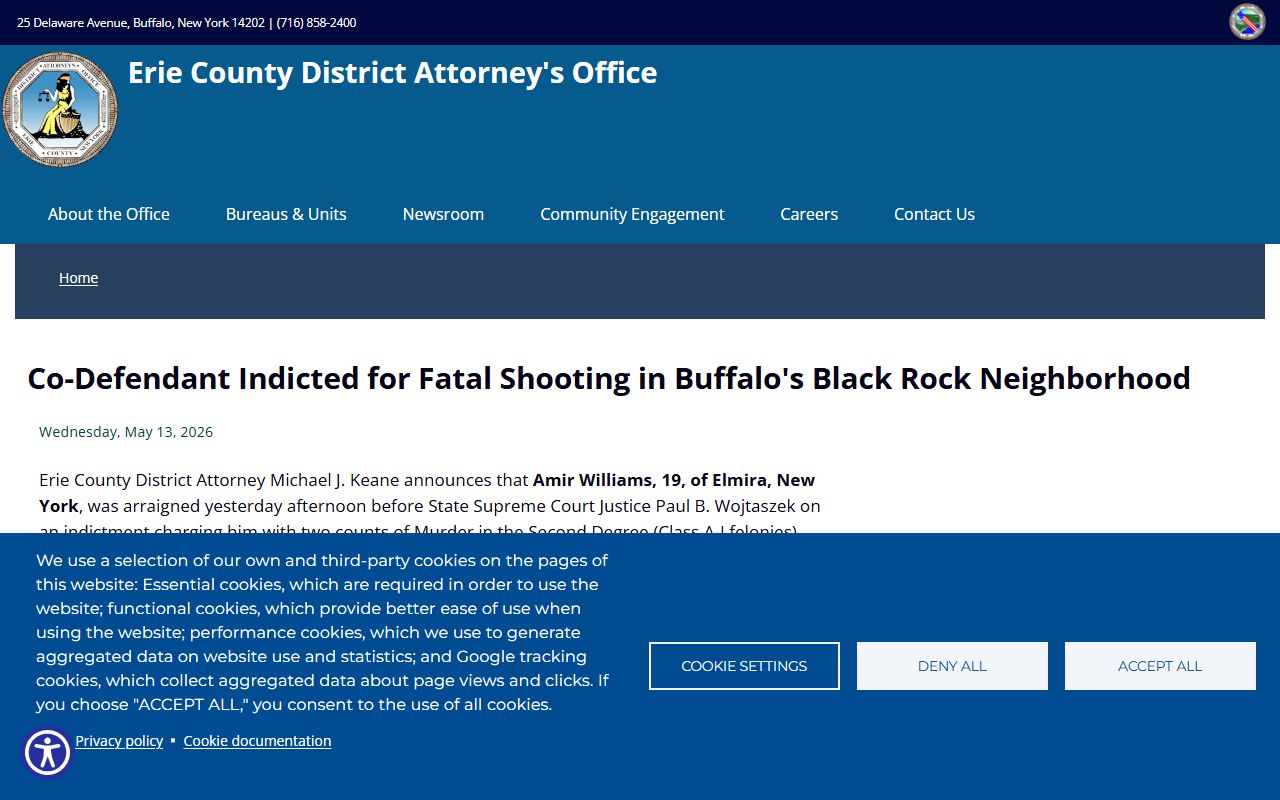
An indictment is a grand jury accusation, not a conviction. It moves a felony case toward trial in County Court.
Background Checks and State Criminal Records
A local roster or court search is not a full criminal history. New York's official statewide criminal history comes from the Division of Criminal Justice Services. A fingerprint-based record check is the formal route for most legal background needs, such as employment screening that the law allows.
Public access to criminal history is limited by law. Agency records fall under the Freedom of Information Law (POL § 87), but a FOIL request cannot override a sealing statute. Youthful offender records are confidential under CPL § 720.35. For DUI and DWI cases, which can be criminal, see traffic court records.