
How to Search Erie County Court Records
Erie County court records live in two systems. County-filed legal records, recorded land documents, judgments, liens, closed criminal files, and historical marriage and divorce records sit with the Erie County Clerk at 92 Franklin Street in Buffalo. Active court cases, calendars, and e-filed documents run through state portals such as WebCivil Supreme, WebCrims, NYSCEF, and WebSurrogate.
The right starting point is the record type, not the court name. A deed search starts with the Clerk. A felony case lookup starts with WebCrims or the County Court chief clerk. A probate file starts with WebSurrogate. The Erie County Clerk public search landing page warns users to try all spelling variations of a name, since older indexing covers immigrant names, hyphenated surnames, business abbreviations, and handwritten entries.
The Erie County Clerk fact sheet says the office processes more than 2 million transactions each year, so the search interface gets heavy daily use. Find the latest portal hours, fees, and request forms on the Clerk site at erie.gov/clerk. The image below shows the Clerk homepage as seen on the day of capture.
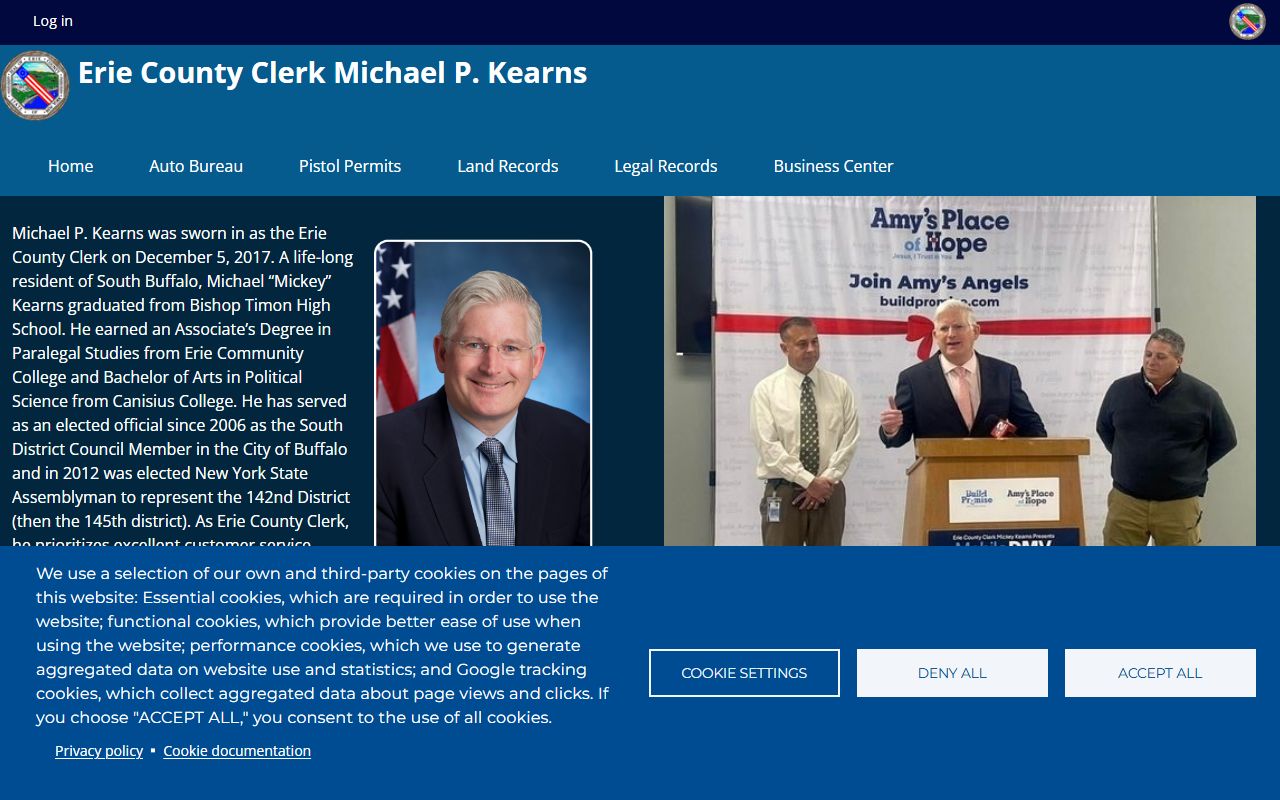
That landing page also names the elected Clerk, Michael P. Kearns, and routes users to land records, legal records, fees, forms, and the public search application.
- Pick the record type first. A deed or judgment starts with the Clerk; a current civil case starts with WebCivil; an e-filed Supreme Court matter starts with NYSCEF.
- Open ecclerk.erie.gov/recordsng_web and read the public-search notice. The Clerk makes no warranty of accuracy and asks users to search alternate spellings.
- If you use Chrome, Firefox, Safari, or a Mac, pick BrowserView. Basic, Advanced, and Registered User Search require Internet Explorer or Microsoft Edge with .NET and ClickOnce.
- Search by party name, document type, instrument number, or book and page. Add a date range when you know one.
- Click View to open the Document tab and check the instrument number, recording date, parties, and any linked filings.
- For a certified copy, note the instrument number and use the Clerk record search and copy request form or visit the Basement Records and Actions and Proceedings counters in person.
The Erie County Judicial System
Erie County sits in the New York State Unified Court System and the Eighth Judicial District, which covers the western New York counties. The trial-court layout is unusual for people who come from other states: New York calls its general trial court the "Supreme Court," and the highest court is the New York Court of Appeals, not a state supreme court. Erie County also has its own County Court, which handles most felony criminal cases outside New York City.
Family Court, Surrogate's Court, Buffalo City Court, and the town and village justice courts handle the rest. The Eighth Judicial District court structure page lists specialized parts in Erie that include commercial, integrated domestic violence, family treatment, juvenile treatment, and other problem-solving programs. The official structure page is online at publicredesign2025.nycourts.gov.
Case flow: Justice Court › Buffalo City Court › County Court › Supreme Court › Appellate Division, Fourth Department › Court of Appeals.
| Court | Jurisdiction | Case Types |
|---|---|---|
| Erie County Supreme Court | General trial court | Civil, divorce, foreclosure, guardianship, complex motion practice, commercial cases |
| Erie County Court | County trial court | Felonies, certain appeals from lower courts, limited civil functions |
| Erie County Family Court | Family matters | Custody, support, paternity, family offense, neglect, juvenile delinquency, PINS |
| Erie County Surrogate's Court | Probate and estates | Probate, administration, accounting, estate guardianship, adoptions |
| Buffalo City Court | Local Buffalo court | Misdemeanors, violations, traffic, small claims to $5,000, civil to $15,000, housing |
| Town and Village Courts | Local justice courts | Traffic, violations, misdemeanors, small claims to $3,000, local code matters |
| Appellate Division, Fourth Department | Intermediate appellate | Appeals from Erie County trial courts |
The image below is from the Eighth Judicial District page describing Erie County's Supreme, County, Family, commercial, IDV, and other parts. See the source at the official court structure page.
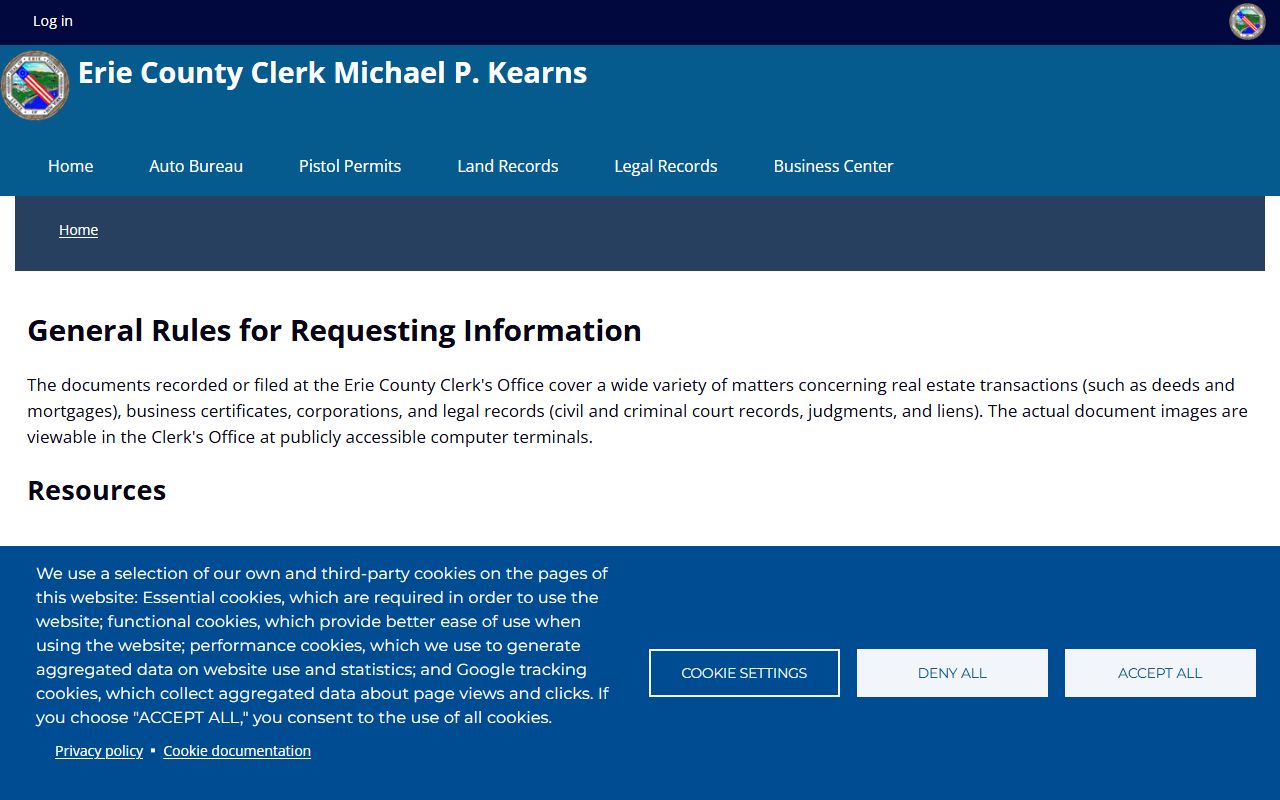
The Clerk's general rules for record requests sit alongside this structure and explain copy fees, public terminals, and FOIL routing.
Erie County Courthouses
Erie County's court campus is spread across downtown Buffalo. A records researcher can move between four buildings in a single day depending on the case type. The Clerk and Surrogate's Court sit in Old County Hall at 92 Franklin Street. Supreme and County Court chief clerk functions sit at 25 Delaware Avenue. Buffalo City Court is at 50 Delaware Avenue. Family Court is at One Niagara Plaza.
Old County Hall, also called Erie County Hall, is between Church Street and West Eagle Street in downtown Buffalo. The Sheriff's main offices are at 10 Delaware Avenue. The federal Robert H. Jackson United States Courthouse is at 2 Niagara Square. Most of these buildings sit within a short walk of each other, but parking and security screening still affect timing.
Erie County Clerk and Surrogate's Court
Old County Hall
92 Franklin Street
Buffalo, NY 14202
716-858-8785 (Clerk)
716-845-2560 (Surrogate's)
Erie County Court Building
Supreme and County Court
25 Delaware Avenue
Buffalo, NY 14202
716-845-9300 (Supreme)
716-845-9301 (Chief Clerk)
Buffalo City Court
50 Delaware Avenue
Buffalo, NY 14202
716-845-2600 main
716-845-2661 criminal records
716-845-2642 housing
Erie County Family Court
One Niagara Plaza
Buffalo, NY 14202
716-845-7444 main
716-845-7401 Record Room
716-845-7420 Petitions
The official Clerk contact page, captured below, lists hours of 9:00 a.m. to 5:00 p.m. Monday through Friday and tells filers to be in line with completed documents by 4:15 p.m. View it directly at erie.gov/clerk/contact-us.
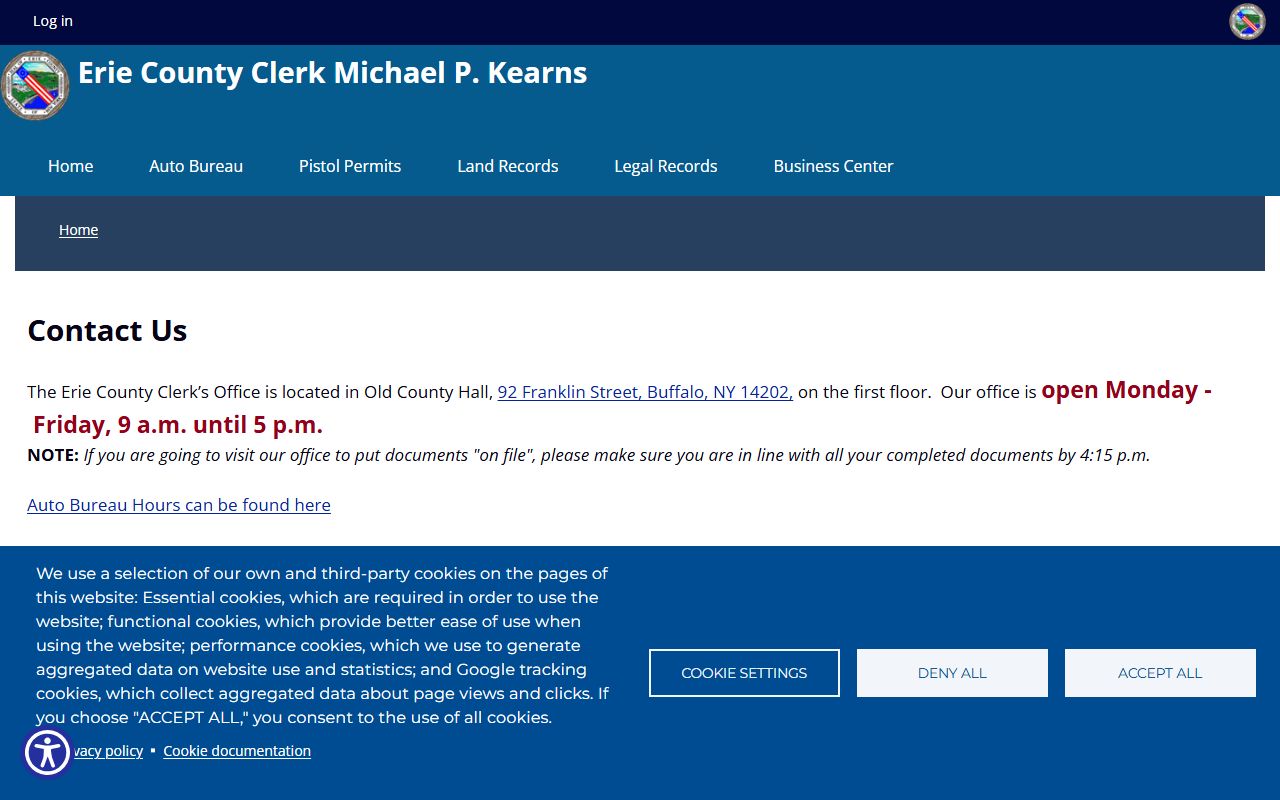
Phone routing on the same page sends civil-action questions, closed criminal record requests, divorce record questions, and judgment questions to different desks inside the Legal Records division.
Types of Erie County Court Records
Erie County court records are not a single category. Each court produces a different file, and the Clerk holds parallel copies of many filings. The split affects where to search and what to expect.
- Supreme Court civil records include summons, complaint, answers, motions, orders, judgments, foreclosure papers, commercial filings, and matrimonial files (sealed for 100 years under Domestic Relations Law § 235).
- County Court criminal records cover felony cases routed after indictment or superior-court information. Closed records may be obtained from the Erie County Clerk Actions and Proceedings office.
- Family Court records include custody, support, paternity, neglect, abuse, family offense, juvenile delinquency, PINS, and adoption petitions. Most are restricted under Family Court Act § 166.
- Surrogate's Court records cover wills, probate, administration, accounting, guardianship, and adoption. Most estate files are public; adoption is sealed.
- Buffalo City Court records include misdemeanors, violations, traffic, civil to $15,000, small claims, and housing court matters.
- Town and village court records cover local traffic court records, violations, code matters, and civil claims to $3,000.
- Clerk land and judgment records include deeds, mortgages, federal tax liens, state tax warrants, mechanic's liens, business filings, and military discharges.
What Erie County Court Records Show
The data inside an Erie County court record depends on the case type and the source system. A WebCivil result shows case status and appearance dates. A BrowserView document detail shows recording metadata. A WebCrims result shows pending criminal calendar data. Knowing the field set helps users compare results and avoid pulling the wrong file.
| Field | What It Shows |
|---|---|
| Case or Index Number | Supreme Court civil cases use an index number; County Court uses docket or indictment numbers; Clerk records use an instrument number and book and page. |
| Filing or Recording Date | The date the case began or a document was recorded; BrowserView also exposes the recording time. |
| Parties | Plaintiff, defendant, petitioner, respondent, decedent, fiduciary, or direct and reverse parties in recorded instruments. |
| Court and Judge | Supreme Court IAS justice and part; Family Court judge and part; City Court judge; the Surrogate. |
| Charges or Cause | The criminal counts, the civil cause of action, or the type of recorded document. |
| Disposition | Pending, disposed, sealed, dismissed, judgment entered, transferred, or active warrant. |
| Financials | Filing fees, judgments, fines, surcharges, restitution, bond amounts, copy fees, and search charges. |
| Attachments | NYSCEF may provide PDFs for e-filed public documents; Clerk BrowserView images are restricted to registered users. |
Status codes matter. Erie County Clerk BrowserView labels a record as "Not Verified" if the status is anything other than V or B, marks R for Replaced Record, and marks C for Correction Record. Users who plan to rely on the record should pull a certified copy.
Public Access Laws for Erie County Court Records
New York court records sit under three overlapping frameworks. Agency records fall under the Freedom of Information Law in Public Officers Law Article 6. Court records fall under Judiciary Law and court rules. County Clerk filings have a separate fee schedule under the Civil Practice Law and Rules. The Erie County Clerk says most Clerk records are already public through the public search and in-office terminals, so a FOIL request is often not needed for a specific filed document.
Key Statutes:
Public Officers Law § 84. Legislative declaration that government is the public's business and records access supports accountability.
Public Officers Law § 87. Lists FOIL exemptions, including unwarranted privacy invasions, law-enforcement interference, and inter-agency materials.
Judiciary Law § 255. Requires court clerks to search and certify search results when proper fees are paid.
CPLR § 8019. Sets county clerk copy fees for preparing and certifying copies.
Domestic Relations Law § 235. Seals matrimonial records for 100 years; access is limited to parties, attorneys of record, or by court order.
A FOIL denial can be appealed within the agency and then challenged through an Article 78 proceeding in New York Supreme Court. A "no record found" response is not proof that nothing happened. It may mean the search hit the wrong office, the wrong court, a sealed file, or a field the system does not index, such as a street address.
Records That Are Sealed or Confidential
Several record types in Erie County are not open in the way ordinary civil filings are. Matrimonial records are sealed for 100 years under DRL § 235. Family Court files are restricted under Family Court Act § 166. Adoption records are sealed under Domestic Relations Law § 114. Youthful offender adjudications are confidential under CPL § 720.35.
Criminal cases that end in favor of the accused are sealed under CPL § 160.50. Eligible old convictions can be sealed under CPL § 160.59 after a waiting period. Marijuana convictions have their own sealing and expungement rules under the state cannabis law. New York is more of a sealing state than an expungement state, so most relief restricts access rather than destroys the record.
Specialty Courts in Erie County
Erie County's specialty parts are run through the Eighth Judicial District. Integrated Domestic Violence Court coordinates criminal, family, and matrimonial issues that involve the same family, so a single judge can see the full picture. Family Treatment Court ties cases where substance use affects family stability to treatment plans, review hearings, and agency coordination. The Family Treatment Court Coordinator is Tari Ann McGinty at 716-845-2741.
The Commercial Division handles business disputes with amounts over $100,000 under 22 NYCRR 202.70(b), including contracts, business torts, shareholder fights, and complex commercial real estate. Juvenile Treatment and other specialized Family Court parts handle minors and Family Court Act proceedings under tighter confidentiality.
Erie County Sheriff and Jail
The Erie County Sheriff's Office is run by Sheriff John C. Garcia, with Undersheriff William J. Cooley. The Sheriff fact sheet describes the office as the largest Sheriff's Office in New York State and the fourteenth largest in the nation, with about 1,018 sworn and 149 civilian employees. The office patrols about 600 square miles, almost 60% of Erie County, and 90 miles of shoreline.
The Sheriff runs two jail facilities. The Erie County Holding Center is at 40 Delaware Avenue in downtown Buffalo. The Erie County Correctional Facility is at 11581 Walden Avenue in Alden. Inmate information is published as a public PDF roster; sentenced state prisoners are tracked through the DOCCS lookup instead. The Sheriff also publishes an active warrants list. Full inmate detail and roster guidance are on the Erie County inmate records page; active warrants are on the warrant records page; jail population context is on the jail population page.
Marriage, Divorce, and Surrogate's Court Records
Marriage and divorce records in Erie County are split. The Erie County Clerk has marriage records from 1878 through April 29, 1935. Modern marriage licenses are issued by the city or town clerk where the license was purchased. Buffalo licenses go through Buffalo City Hall Marriage Records at 65 Niagara Square. Divorce records sit with the Clerk from the early 1800s to the present, but matrimonial files are sealed under DRL § 235. More detail is on the Erie County marriage and divorce records page.
Probate, estate, will, and adoption matters go through Erie County Surrogate's Court at 92 Franklin Street, second floor, with the Hon. Acea M. Mosey as the Surrogate. Public estate files are searchable through WebSurrogate and through the Public Access Room 201 on the second floor.
The image below shows the Clerk's official divorce-record instructions, including the rule that the critical search date is the date the action commenced, not the judgment date. See the source at erie.gov/clerk/divorce-records.
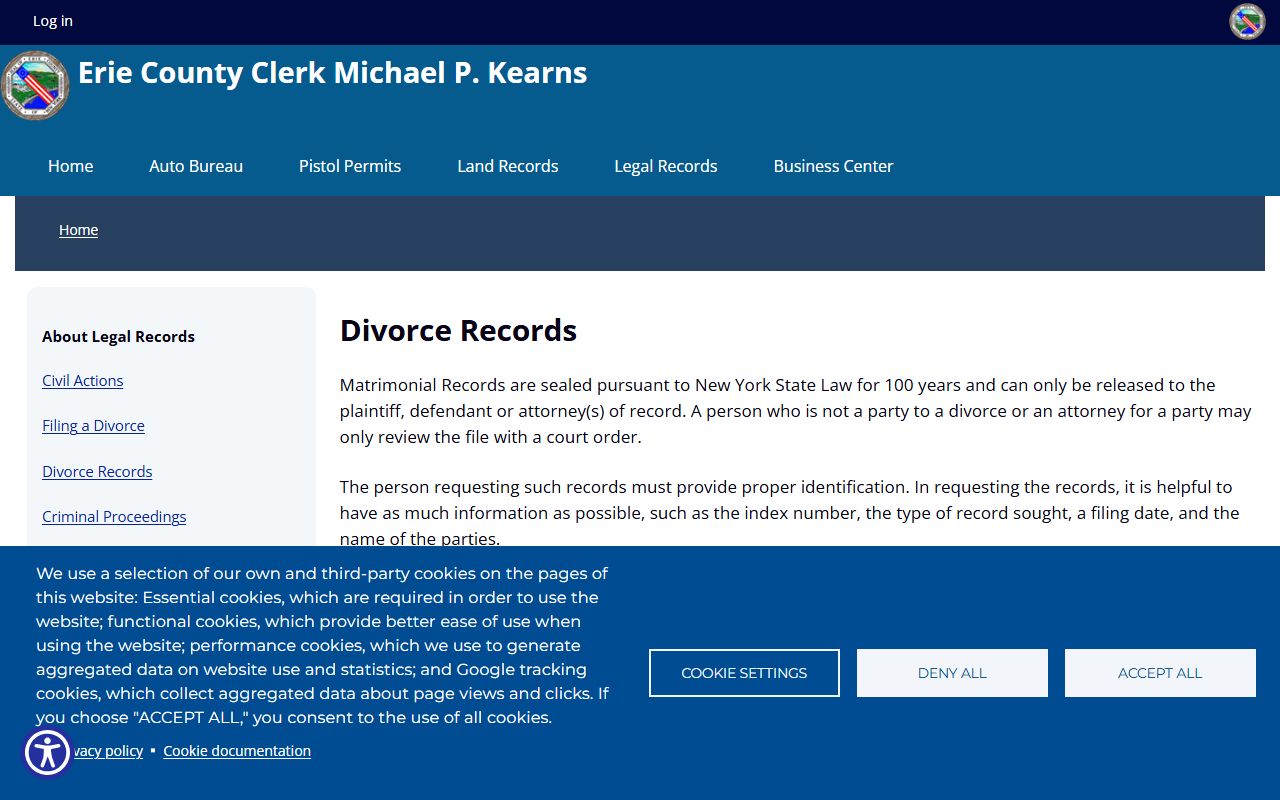
The page also explains that a sealed divorce record requires a written, notarized statement and proper identification before the Clerk can release a copy.
- Testator
- A person who has made a will.
- Executor
- The person named in a will to administer the estate.
- Administrator
- The person appointed by the Surrogate when there is no will.
- Letters Testamentary
- The Surrogate's order giving an executor authority to act.
- Letters of Administration
- The Surrogate's order giving an administrator authority to act.
- Intestate
- Dying without a will.
Erie County Court Records Fees
The Erie County Clerk fee schedule mirrors CPLR § 8019 and CPLR § 8021. Copies of recorded documents and certified copies have set per-page rates with a maximum charge per document. Search fees scale by two-year period and by name. The official schedule sits at erie.gov/clerk/schedule-fees.
| Item | Amount |
|---|---|
| Copies, first 2 pages | $1.30 |
| Copies, each additional page | $0.65 |
| Certified copies, first 4 pages | $5.00 |
| Certified copies, each additional page | $1.25 |
| Certified presented copies, first 8 pages | $5.20 |
| Maximum charge per document | $40.00 |
| Manual search, per 2-year period per name | $10.00 |
| Digital search, per 2-year period per name | $5.00 |
| Certificate of search of court records | $5.00 per name or record type |
The captured fee schedule below shows the same numbers in their official layout. View it at the Clerk fee schedule page.
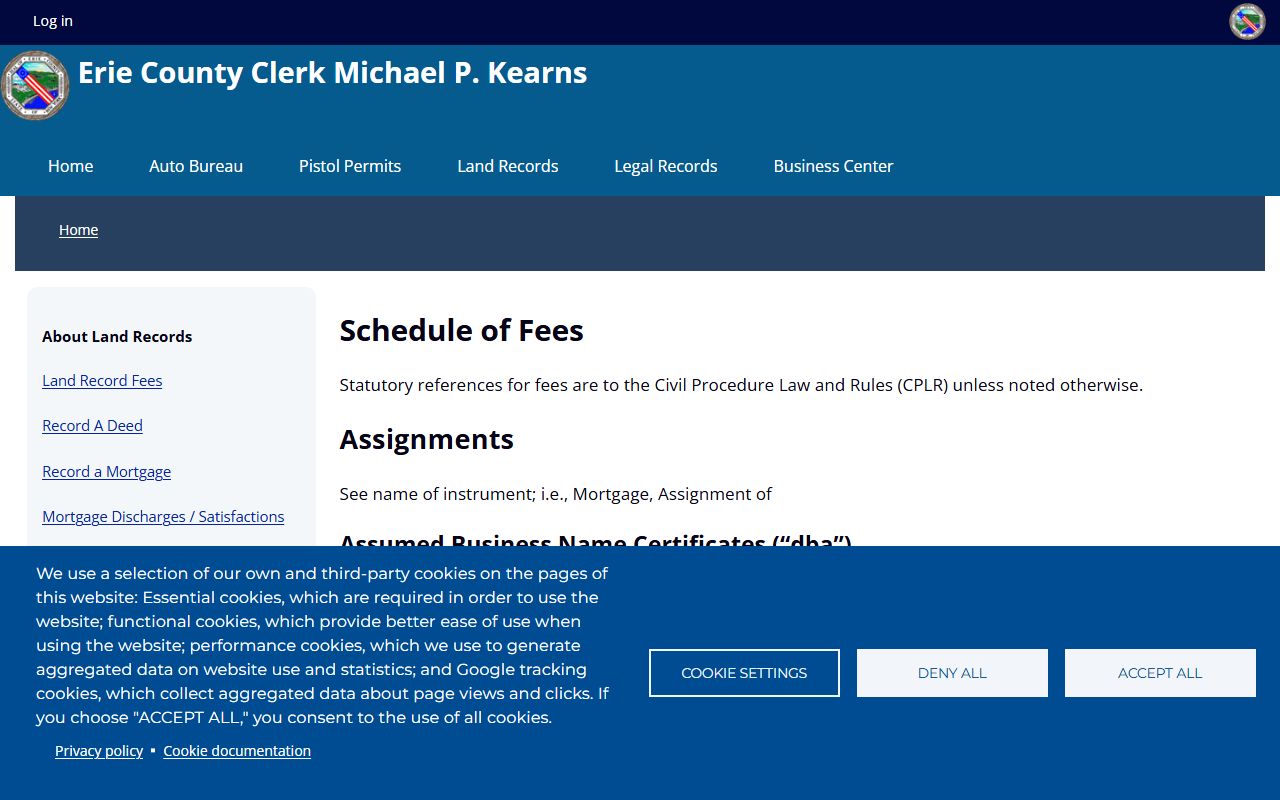
These rates apply to Clerk-held filings. State court filing fees, NYSCEF e-filing fees, and federal PACER fees follow different statutes.
The Erie County Clerk Public Search Portal
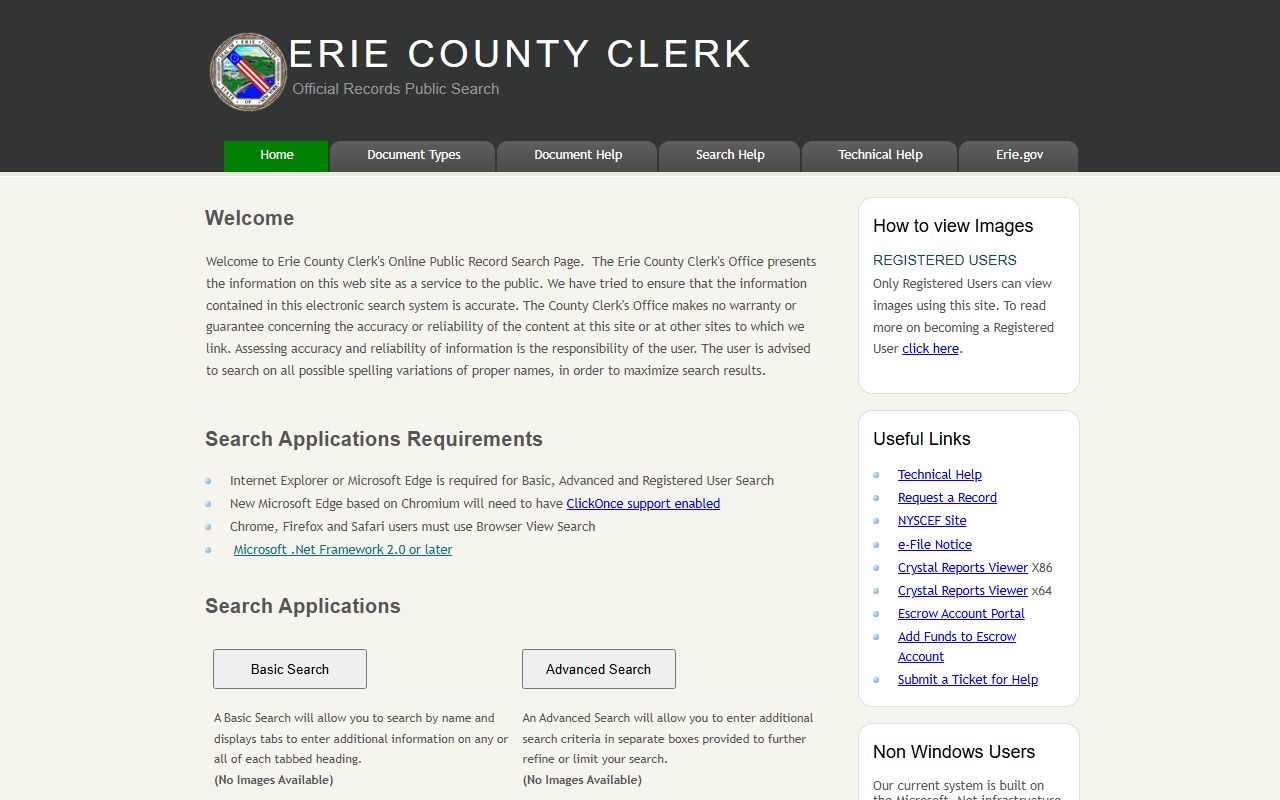
The Erie County Clerk runs the Official Records Public Search application at ecclerk.erie.gov/recordsng_web. The site offers three flavors: Basic Search, Advanced Search, and Registered User Search. Basic and Advanced run only on Internet Explorer or Microsoft Edge with .NET and ClickOnce support enabled. Chrome, Firefox, and Safari users fall back to BrowserView at ecclerk.erie.gov/BrowserView.
The portal landing page is captured below. View it at the public search landing page.
BrowserView is the cross-browser option. Its search field table is below.
| Field Label | Type | Required | Notes |
|---|---|---|---|
| Party Name | Text | Yes for party search | Last name first, no comma; business names allowed; try alternate spellings. |
| Document Type | Text with checkbox tree | No | Comma-separated codes such as MTG; expandable document-type groups. |
| From Date | Date | No | MM/DD/YYYY format. |
| To Date | Date | No | MM/DD/YYYY format; shortcut buttons for 7, 30, and 90 days. |
| Instrument Number | Text | Yes for instrument search | Numeric or alphanumeric; example 1999002121. |
| Book and Page | Text | Yes for book search | Book type from drop-down; numeric page reference. |
| Consideration Amount | Text | No | Results equal to or greater than entered amount; format 1000.01. |
The image below shows the BrowserView interface itself. View it at ecclerk.erie.gov/BrowserView.
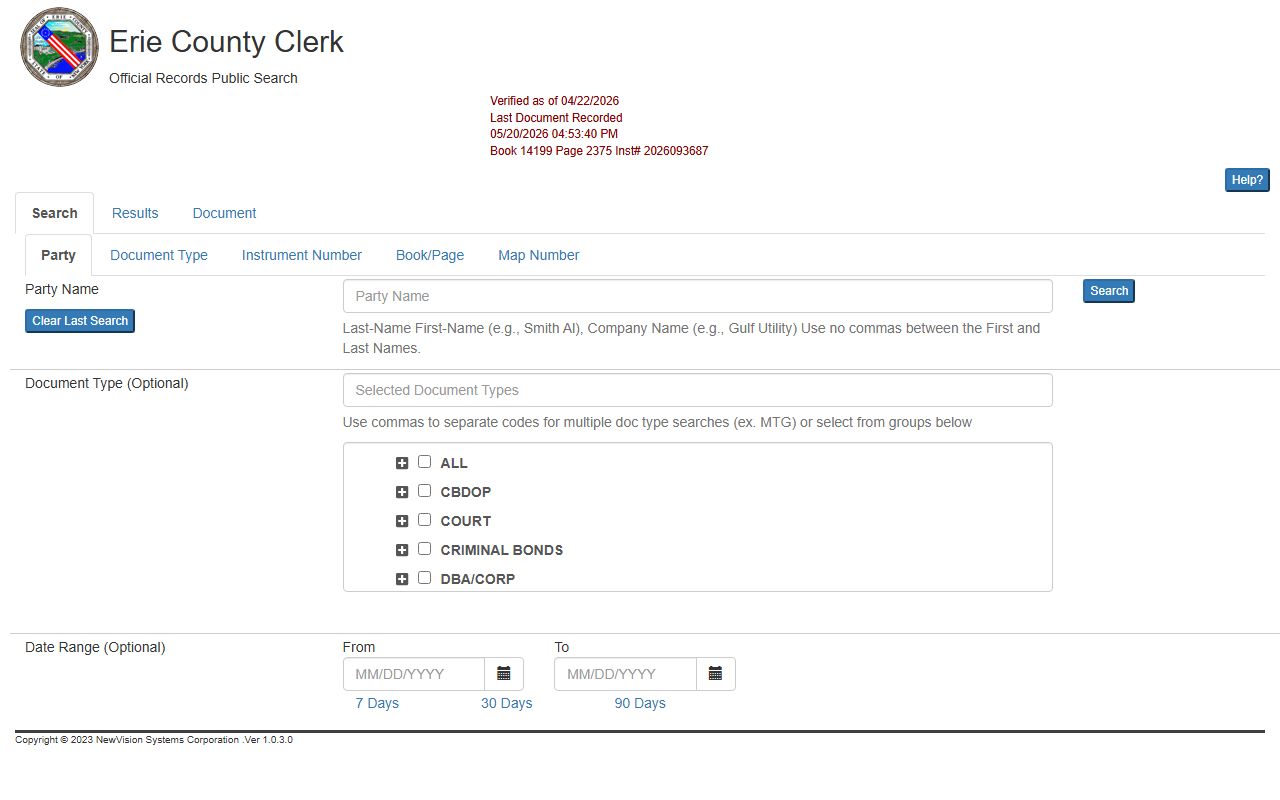
BrowserView returns document metadata but does not display the actual image. Users who need to see scanned filings should register, use a public terminal at the Clerk's Office, or order a copy.
How to Interpret Erie County Court Records
Erie County Clerk pages use terminology that can confuse general readers. "Actions and Proceedings" refers to the desk that handles legal and court record work. "Basement Records" refers to the in-person copy counters and public terminals. "Direct" and "reverse" parties replace plaintiff and defendant on many recorded instruments. "Instrument number" is the recorded-file identifier; "book and page" is the older or parallel reference.
Reading a result the right way starts with the source. A WebCivil hit means a Supreme Court civil status. A BrowserView hit means a recorded or filed document. A WebCrims hit means a criminal calendar item. A Sheriff warrant hit means an active warrant entry, not a court docket. Once the source is clear, confirm identifiers, party spelling, dates, and whether documents are viewable, restricted, or image-only at the courthouse.
A criminal record also draws a clear line between charges and convictions. A pending case is not a conviction. A dismissed or sealed case may still appear in some private background reports but cannot be relied on as a conviction. Disposition matters more than the charge.
Accuracy and Record Limitations
The Erie County Clerk landing page tells users the office makes no warranty of accuracy and asks them to try alternate spellings of proper names. Older entries cover hyphenated surnames, apostrophes, middle initials, business suffixes, and handwritten indexes. Address searches are not supported because the Clerk does not index by address; users with only a property address should start with the Real Property Parcel Search to find the deed reference.
State court systems also lag. WebCrims may not show closed, sealed, or youthful offender cases. WebSurrogate may not surface very old or sensitive matters. NYSCEF will not display sealed or confidential documents in a public guest search. For legal reliance, a certified copy from the relevant clerk's office is the safe path.
Note: Always confirm record detail with the originating Erie County office before relying on it for a hearing, filing, or transaction.
History of Erie County Courts
Erie County was created in 1821. On February 4, 1821, John G. Camp was appointed the first sheriff. The Sheriff's Office describes itself as the oldest constitutional law-enforcement office under the common law. The Erie County Holding Center's roots reach back to a jail described as "plainly built of Graystone" in 1877.
Old County Hall at 92 Franklin Street anchors much of the county's legal-record geography. The Clerk has been on the first floor and Surrogate's Court on the second floor for generations. The downtown court campus expanded across Delaware Avenue and Niagara Plaza in the modern era, and electronic filing through NYSCEF, EDDS, WebCivil, WebCrims, and WebSurrogate now sits on top of those older systems.
The Erie County Clerk's genealogy resources include marriage records from 1878, naturalization records, military discharges, deeds, and historical divorce filings. The image below shows the genealogy page.
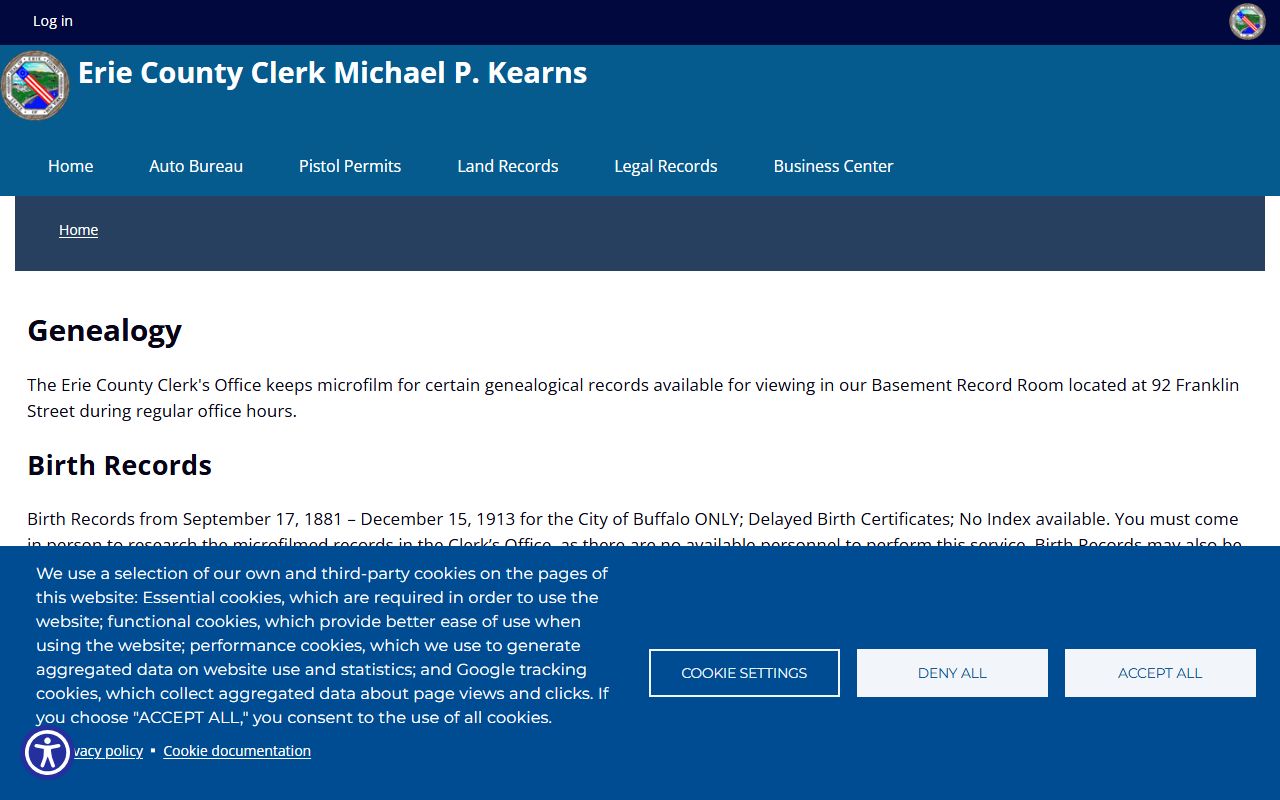
Researchers who need pre-1935 marriage records or older naturalization files generally start with the record room at 92 Franklin Street.
Legal Help and Court Accommodations
People who cannot afford counsel in Erie County have several options. The Assigned Counsel Program covers eligible criminal and Family Court matters. The DA's Conviction Integrity Unit reviews plausible wrongful-conviction claims. Legal Aid Bureau of Buffalo and Neighborhood Legal Services handle civil and family work. The Bar Association of Erie County runs a lawyer-referral service. New York CourtHelp publishes statewide forms and self-help guides.
Court interpreters are free. Litigants and attorneys should ask early so the court can schedule the right language or sign interpreter. Buffalo City Court's Chief Clerk's Office is at 716-845-2689. ADA accommodations for Supreme, County, and Surrogate's Courts route to the District Executive, Brandon A. Portis, Esq., at 716-845-2505. Family Court runs a YWCA Children's Center at One Niagara Plaza, first floor, at 716-845-7211.
Frequently Asked Questions
How do I search Erie County court records online?
Pick the portal by record type. Clerk BrowserView holds filed and recorded legal records, deeds, judgments, and liens. WebCivil Supreme covers New York Civil Supreme Court status and calendars statewide. NYSCEF holds e-filed Supreme, County, and Surrogate's Court documents. WebCrims covers eligible public criminal calendar data. WebSurrogate handles probate. Cases in Buffalo City Court or a town or village justice court may require direct contact with that court if the state portal does not show them.
Where is the Erie County Clerk located?
The Erie County Clerk's Office is on the first floor of Old County Hall at 92 Franklin Street, Buffalo, NY 14202. The main phone is 716-858-8785. Hours are Monday through Friday, 9:00 a.m. to 5:00 p.m. The office asks filers to be in line with completed documents by 4:15 p.m. The elected Clerk is Michael P. Kearns.
Are Erie County divorce records public?
No, they are sealed for 100 years under DRL § 235 and can only be released to a plaintiff, defendant, or attorney of record. A nonparty needs a court order. The request must include proper ID and a written, notarized statement. The critical search date is the action commencement date, not the judgment date.
How do I find an Erie County inmate?
Start with the Sheriff's public PDF roster. If the person is not on the current roster, check DOCCS for state custody, the BOP locator for federal custody, and VINELink for custody-status notifications. The court docket may show bond, sentence, or warrant status. See the inmate records page for the full guide.
More questions and longer answers are on the Erie County Court Records FAQ page.